Installed Cost Range
For a typical 400-square-foot Phoenix garage, professionally installed interlocking tile may run $2,000-$3,600, DIY rolled matting $1,200-$2,400, and poured or liquid rubber $3,500-$6,000.
For Phoenix-area garages, Phoenix Rubber Flooring typically sees installed rubber floor pricing range from $3 to $12 per square foot. Product type, slab preparation, garage layout, and the choice between interlocking tile, rolled matting, or poured rubber determine where a project falls within that range.
For a typical 400-square-foot Phoenix garage, professionally installed interlocking tile may run $2,000-$3,600, DIY rolled matting $1,200-$2,400, and poured or liquid rubber $3,500-$6,000.
Garage size, layout, slab cracks or pitting, moisture, product thickness, surface finish, and the choice between DIY and professional installation all change the total.
Multiply the garage square footage by the rate for the chosen product, then add 10-15% for waste, trim, and threshold transitions. Compare whether each quote also includes prep and moisture work.
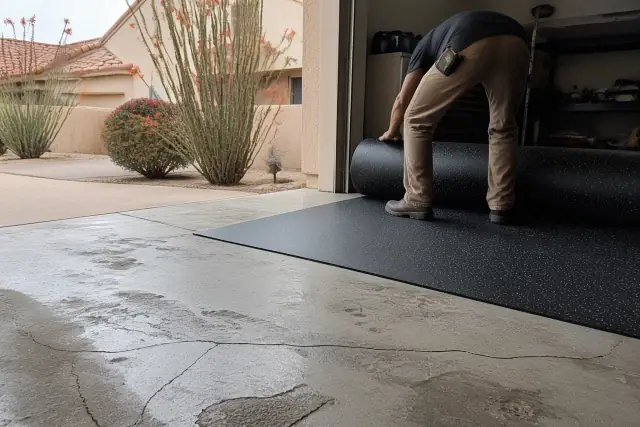
The bare concrete slab with visible cracks, pitting, and a moisture-test area. These conditions can add grinding, patching, or moisture-mitigation cost before rubber is installed.
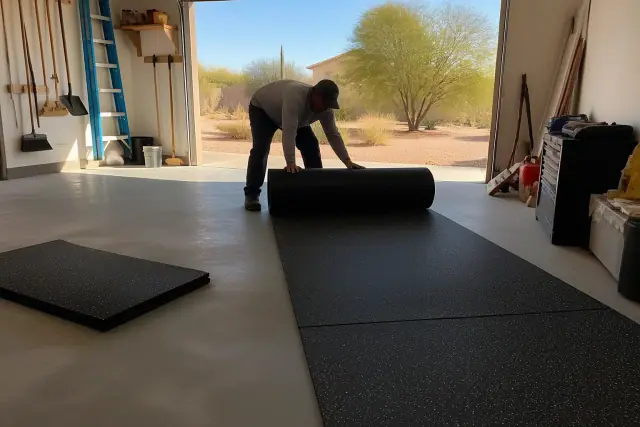
The thickness difference between lighter residential matting and 3/4-inch rubber used for home gyms, lift bays, or heavier point loads. Greater thickness and density raise material cost.
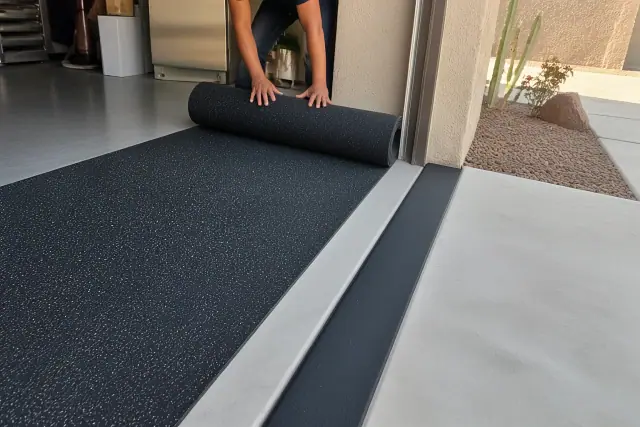
Aligned tile or roll seams, perimeter edging, and the transition at the garage door. These details separate a material-only price from a complete installed quote.
Installed residential pricing averages $4-$8 per square foot for interlocking tile, $3-$6 for rolled matting, and $8-$16 for poured rubber.
Rubber tiles typically cost $3-$7 per square foot for material alone, with listed retail options from $2.00-$6.99. Interlocking material runs $3-$8, rolled matting $1.50-$4, and liquid rubber coating $2-$5 per square foot.
A professionally installed two-car floor typically totals $2,500-$4,500 when moisture testing, degreasing, minor crack repair, and perimeter trim are included. DIY interlocking tile can save 30-40%, but poor prep may lead to shifting or curled edges.
Commercial-grade rubber for auto lifts, converted home gyms, or small fleet bays typically costs $6-$14 per square foot installed. Seamless poured rubber runs about $8-$14 and thicker 3/4-inch products cost more because they use denser material and reinforced seams.
| Garage Size | Interlocking Tile | Rolled Matting | Poured Rubber |
|---|---|---|---|
| 1-car (200 sq ft) | $1,000-$2,000 | $600-$1,200 | $1,600-$2,800 |
| 2-car (400 sq ft) | $2,000-$4,000 | $1,200-$2,400 | $3,200-$5,600 |
| 3-car (600 sq ft) | $3,000-$6,000 | $1,800-$3,600 | $4,800-$8,400 |
An installed quote can include the rubber product, grinding, patching, moisture mitigation, adhesive or interlocking hardware, labor, seams, and threshold trim. For a 400-square-foot two-car garage, a typical breakdown is $1,200-$3,200 for material, $400-$1,200 for labor, and $200-$500 for prep and trim, bringing most projects to $1,800-$4,900. Materials generally represent 50-65% of tile and roll project cost but closer to 40% for poured systems.
Phoenix summer slab temperatures regularly exceed 140 degrees Fahrenheit, so rubber compound and high-heat adhesive selection matter. Original 1950s-60s slabs in Encanto or Coronado may have more pitting, while newer slabs in Ahwatukee or Verrado can require less prep. Across a metro with 5.19 million residents and a city footprint of 517.9 square miles, common uses include home gyms and RV or truck storage, which may call for more durable rubber grades.
Rubber is well suited to garages because it cushions impact, dampens sound, and flexes with minor slab movement; across all product types, it can cost $1-$16 per square foot. A 20x20 epoxy floor, or 400 square feet, typically costs $1,600-$4,000 at $4-$10 per square foot, while premium finishes can approach $5,000. Rubber's tradeoffs include initial odor, UV fading, shifting on an uneven subfloor, and pressure indentations under long-term static loads. Properly installed rubber typically lasts 15-20 years, heavier-duty poured or 3/4-inch floors can exceed 20 years, and epoxy may require recoating every 5-10 years.
A site walkthrough can account for the garage dimensions, slab damage, moisture, product choice, and transition details that a phone estimate may miss. Request a written estimate based on the conditions in your garage before work begins.