Proudly serving Phoenix, Mesa, Chandler, Scottsdale, Gilbert, Tempe & surrounding areasCall or Text 24/7: +1 (480) 916-7433

Rubber Floor Tile Installation in Phoenix, AZ for Modular Gym and Commercial Applications

Phoenix Rubber Flooring installs rubber floor tile, interlocking modular rubber systems, poured-in-place rubber, and rubber mats across Phoenix. We serve homes, gyms, schools, healthcare spaces, retail properties, offices, and commercial buildings. Project scopes range from a 400-square-foot home gym in Ahwatukee to a 20,000-square-foot warehouse floor in the Deer Valley industrial corridor. Our crews match the flooring system to the building, traffic, and load instead of treating every space the same.

Phoenix slabs face expansive clay soils, dust infiltration, and summer surface temperatures that push past 150 degrees on exposed concrete. Those conditions can contribute to cracks, pits, stress-fracture telegraphing, and poor adhesive performance when preparation is rushed. We test slab moisture, evaluate flatness, and account for heat and UV exposure near windows and garage doors. That careful preparation helps the selected rubber surface lie flat and perform under the demands of the space.

Our licensed and insured crews coordinate with property managers and general contractors, pull permits when the scope requires them, and provide a written material-and-labor estimate before work starts.

Phoenix Rubber Flooring provides rubber floor tile installation in Phoenix, Scottsdale, Tempe, Mesa, Chandler, Glendale, and the broader Maricopa County metro area.

★ ★ ★ ★ ★4.9/5 Average Rating · 20+ Years of Experience · Thousands of Customers Helped · Licensed & Insured · Residential & Commercial

Rubber Flooring Options & Benefits

What Is Rubber Floor Tile Installation?

Rubber floor tile installation creates a resilient surface from interlocking or adhesive-set modular tiles. The format makes it possible to select the density, thickness, pattern, and material that fit the expected traffic and use.

Available systems include closed-cell EPDM rubber, recycled SBR rubber, rolled sheet goods, mats, and poured urethane-bound surfaces. Colored tile can use flecked, solid, or marbled patterns where brand color or visual zoning matters.

The installation begins with a flat, clean, moisture-tested substrate. System selection then considers foot traffic, drop-weight loads, rolling equipment, hygiene needs, UV exposure, removability, and the transitions around the room.

Benefits of Rubber Flooring

Rubber flooring is useful where impact comfort, wet traction, low-maintenance cleaning, and resistance to demanding traffic matter more than the rigidity of a hard surface.

  • Textured surfaces provide better wet traction than polished tile or sealed concrete.
  • Resilient material absorbs impact beneath exercise and training areas.
  • Dense rubber helps protect concrete beneath free weights and heavy equipment.
  • Quality rubber flooring can last 15 to 20 years under normal commercial traffic.
  • Routine care uses a damp mop and neutral pH cleaner without grout sealing or wax stripping.
  • Poured surfaces eliminate seams where hygiene, moisture, or rolling traffic is a concern.
  • Recycled options divert tire and manufacturing waste from landfill.
  • Low-VOC products reduce off-gassing concerns in enclosed gyms and classrooms.
Rubber Flooring Services

Rubber Floor Tile Installation Services

We install modular tile, adhesive-set tile, sheet goods, mats, and poured rubber for residential, athletic, educational, healthcare, retail, office, and industrial spaces.

Rubber Floor Tile Installation

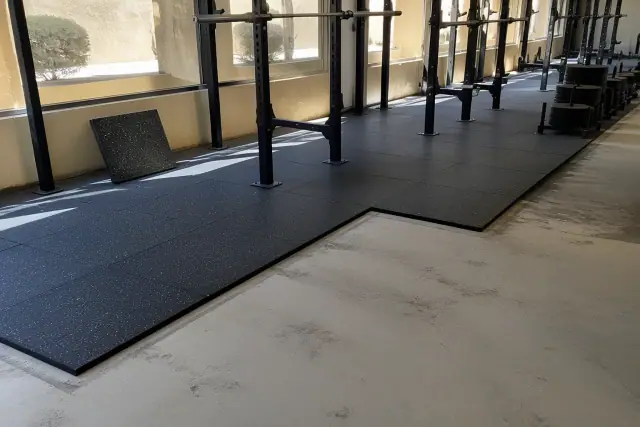
Technician installing rubber floor tiles in a fitness center free weight zone in Phoenix, AZ.

Modular rubber tile provides a durable, serviceable floor for rooms that need shock absorption, traction, and defined color or pattern choices. We plan the layout around walls, equipment, transitions, and the building's subfloor conditions.

Request Estimate

Interlocking Modular Rubber Tiles

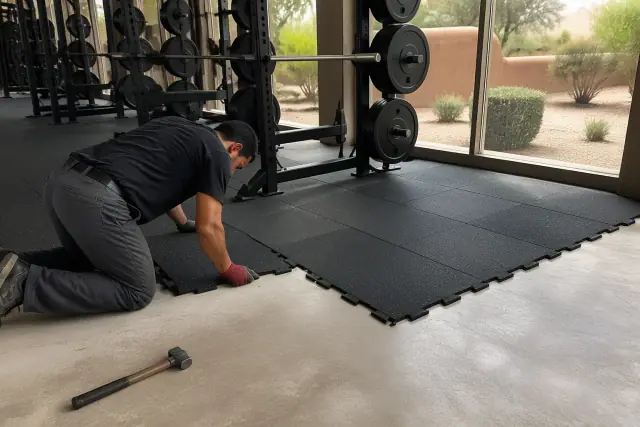
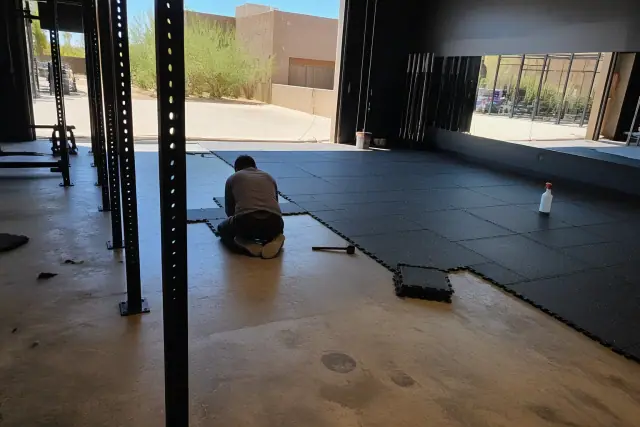
Technician installing heavy-duty rubber floor tiles in a Phoenix, AZ fitness center free weight zone.

Interlocking tile is dry-laid without adhesive and can be lifted or reconfigured later. It suits event spaces, trade show booths, rental properties, and other installations where removability matters.

Request Estimate

Glue-Down Rubber Tile

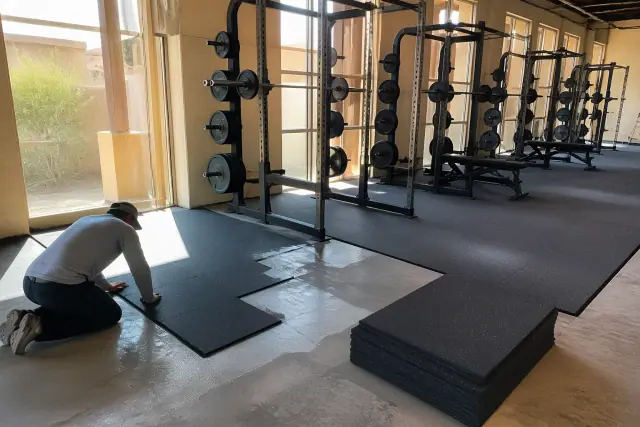
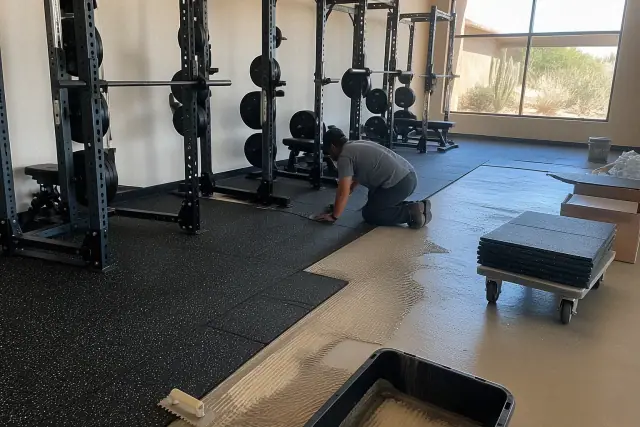
Technician installing glue-down rubber floor tiles in a Phoenix, AZ fitness center free-weight zone.

Glue-down tile creates a stable surface for permanent installations and heavier traffic. Adhesive is troweled across a prepared, moisture-tested slab, and each tile is seated before the adhesive skins over.

Request Estimate

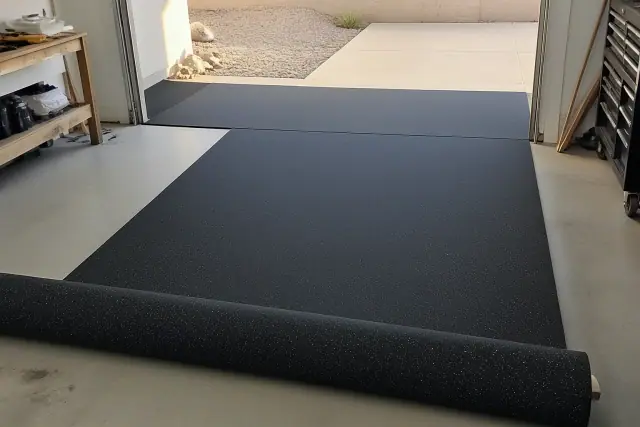
Rolled Rubber and Mat Installation

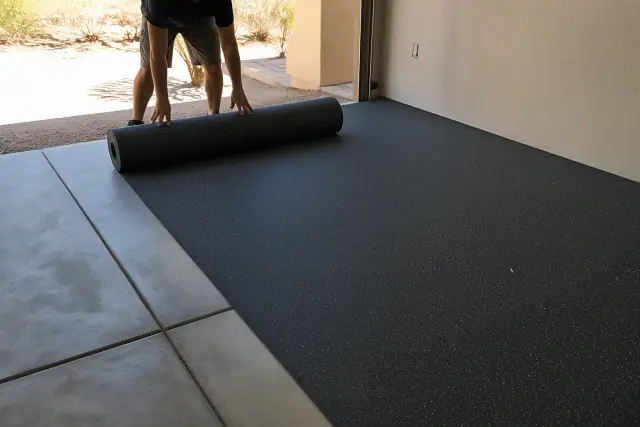
Worker unrolling recycled rubber flooring in a Phoenix, AZ garage workshop.

Rolled sheet goods cover larger zones with fewer seams, while mats work well for smaller workout areas and equipment stations. Correct seaming and transition work keeps edges flat where foot traffic crosses the surface.

Request Estimate

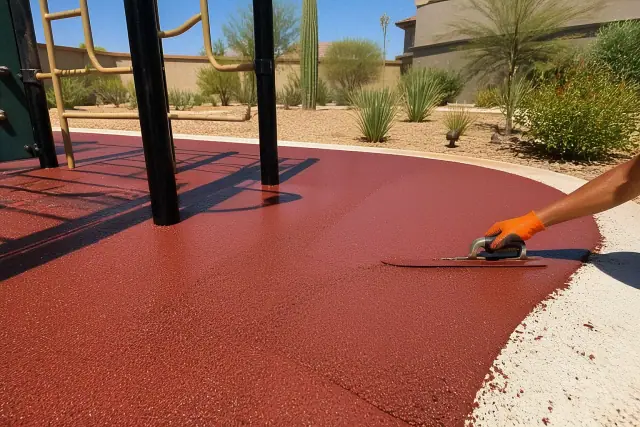
Poured-in-Place Rubber Flooring

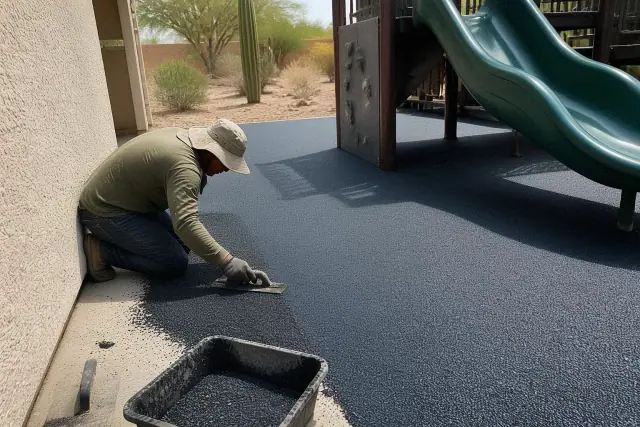
Technician troweling poured-in-place rubber flooring at an outdoor playground in Phoenix, AZ.

Poured rubber combines EPDM granules with a urethane binder and is troweled into one continuous, self-leveled surface. It cures in 24 to 48 hours depending on ambient temperature and humidity, with summer pours scheduled early to control surface temperature.

Request Estimate

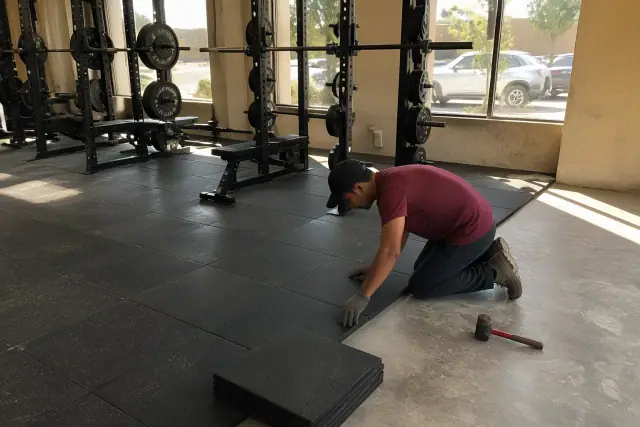
Gym and Commercial Rubber Flooring

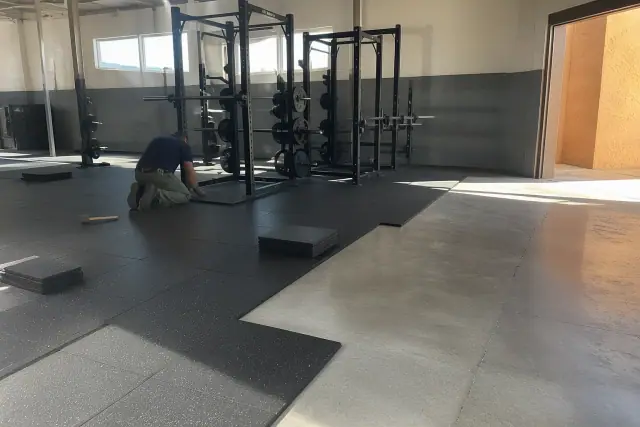
Technician installing rubber gym flooring tiles on a concrete slab in a Phoenix, AZ fitness facility.

For free-weight and turf zones, we install rubber tile from 3/8-inch to 3/4-inch based on the expected drop-weight load. Squat racks and platform zones may call for higher-density rubber that is 1 inch or thicker, with impact attenuation considered in relation to ASTM F355 testing guidance.

Request Estimate
Rubber Flooring Options

Types of Rubber Flooring Options

The right format depends on whether the project prioritizes removability, a permanent bond, fewer seams, a monolithic finish, specialized facility performance, or a particular material profile.

Technician installing heavy-duty interlocking rubber floor tiles at a fitness center in Phoenix, AZ.

Interlocking Rubber Tile

Interlocking modules connect edge to edge and are laid from a chalk-lined center point so the pattern stays square with the room.

  • Dry-laid without adhesive
  • Removable and reusable
  • Useful for temporary spaces
  • Individual tiles can be reconfigured
  • Careful seating helps prevent curled edges
Request Estimate
Technician installing rubber floor tiles in a Phoenix, AZ fitness center free weight zone.

Glue-Down Rubber Tile

Adhesive-set tile is intended for a secure, permanent installation over a properly prepared substrate.

  • Stable under regular traffic
  • Notched-trowel adhesive application
  • Requires a clean, dry bond surface
  • Supports flecked, solid, or marbled layouts
  • Dry-fitting catches layout issues before bonding
Request Estimate
Rolled rubber flooring being installed on a concrete garage floor in Phoenix, AZ.

Rolled Rubber Sheets and Mats

Sheets and mats offer broad resilient coverage for training zones, equipment areas, and spaces where fewer tile joints are preferred.

  • Fewer seams across larger areas
  • Mats suit defined equipment stations
  • Sheet goods require accurate seaming
  • Transitions need flat, secure edges
  • Small mats can work for simple DIY areas
Request Estimate
Technician troweling EPDM rubber granules for a play surface installation in Phoenix, AZ.

Poured EPDM Rubber

A urethane-bound EPDM pour creates a seamless floor plate for spaces where joints could collect moisture or catch rolling equipment.

  • Monolithic surface with zero seams
  • Mixed and troweled on site
  • Useful in wet and hygiene-sensitive spaces
  • Handles repeated rolling traffic without tile edges
  • Custom color blending can affect project cost
Request Estimate
Technician installing heavy-duty rubber floor tiles in a Phoenix, AZ fitness center weight zone.

Specialty Commercial Rubber

Commercial properties can select rubber surfaces around infection-control expectations, static control, entry traction, visual branding, and maintenance needs.

  • Static-dissipative sheet goods for healthcare settings
  • Antimicrobial rubber options for patient corridors
  • Colored tile for retail and office branding
  • Textured entries for wet-traction needs
  • Low-VOC choices for enclosed occupied spaces
Request Estimate
Finding Your Right Fit

Choosing the Right Rubber Flooring Approach

We compare substrate moisture, slab flatness, traffic, impact, rolling loads, hygiene, UV exposure, color, and future removability before recommending tile, sheet, mat, or poured rubber.

Moisture-Tested Subfloor Preparation

We prepare subfloors to ASTM F710 standards and use calcium chloride and relative humidity testing on slab-on-grade installations. Grinding, patching, and vacuuming remove irregularities, curing compounds, and efflorescence that can interfere with adhesion.

Phoenix Slab and Climate Knowledge

Our work near South Mountain, along the Camelback corridor, and in the Sky Harbor logistics zone informs how we plan for soil movement, heat cycles, dust, and sun exposure on local slabs.

Licensed and Insured Coordination

Phoenix Rubber Flooring operates as a licensed Arizona contractor and carries liability insurance on residential and commercial jobs. We coordinate commercial scopes with property managers and general contractors and pull permits through the City of Phoenix Development Services Department when required.

What Sets Us Apart

Why Choose Us for Rubber Floor Tile Installation?

Our installers train on rubber and resilient flooring systems, including modular tile, poured urethane-bound surfaces, seaming, expansion, and adhesive requirements. A walkthrough and itemized written estimate clarify the recommended material, labor, preparation, and moisture-mitigation needs before installation begins.

Request Written Estimate

Slab Cracks and Unevenness

Cracks, pits, and low spots can telegraph through rubber or prevent modular tile from sitting evenly. Expansive clay soils and Phoenix heat cycles make a careful slab evaluation especially important before layout.

Elevated Concrete Moisture

Moisture moving through a slab can become trapped below the finished surface. Testing determines whether the assembly needs a vapor barrier or moisture-mitigating primer before adhesive or underlayment is installed.

Adhesive Bond Failure

Dust, efflorescence, curing compounds, or excess moisture can block the bond between rubber and concrete. The result may be loose tile, lifted edges, or adhesive failure that requires repair.

Edge Curling and Tile Gaps

Uneven tension, poor seating, weak transitions, and layout errors can create gaps or curled modular edges. Larger rooms are less forgiving because small alignment errors compound as each row is installed.

Heat and UV Exposure

West-facing glass, garage doors, and unshaded rooms expose flooring to sustained desert sun and thermal movement. Material selection and installation planning need to account for those conditions rather than relying on an indoor-only assumption.

Impact and Rolling Loads

Repeated barbell drops concentrate force at platform zones, while carts and rolling equipment work against exposed seams. Density, thickness, compression layers, and surface format should reflect the actual load path.

How it works

Our Rubber Floor Tile Installation Process

The process moves from site evaluation and testing through substrate preparation, system selection, installation, curing, and final handoff. Each step is adjusted for the selected tile, mat, sheet, or poured surface.

01.

Walkthrough and Written Estimate

We measure the space, review access and existing floor removal, identify how the room will be used, and provide a written quote that separates material and labor.

02.

Moisture and Humidity Testing

We run calcium chloride and relative humidity tests on slab-on-grade installations. A calcium chloride result above 5 pounds per 1,000 square feet per 24 hours calls for a vapor barrier or moisture-mitigating primer before the next layers go down.

03.

Grind, Patch, and Vacuum

The crew removes bond-blocking residue, repairs the slab, and corrects any depression greater than 3/16 inch over 10 feet before installation. Vacuuming leaves a clean surface for adhesive, primer, or underlayment.

04.

Select the System and Layout

We confirm EPDM or recycled SBR material, density, thickness, color, pattern, underlayment, transitions, and whether the surface should interlock, glue down, roll out, or be poured.

05.

Install the Rubber Surface

Interlocking tiles are aligned from a chalk-lined center point, glue-down tiles are set into wet adhesive, and poured surfaces are mixed, troweled, and self-leveled in a continuous pour. A full row is dry-fit before adhesive work to catch layout issues.

06.

Cure, Finish, and Handoff

We manage cure conditions where adhesives or binders are used, finish edges and transitions, and review the completed surface and maintenance approach before the space returns to use.

Plan Your Flooring Project

Schedule a Rubber
Flooring
Walkthrough

Tell us how the space will be used, and we will measure the floor, test the substrate, compare suitable rubber systems, and prepare a written estimate.

Service Help

Rubber Floor Tile Installation FAQs

These answers cover rubber flooring pricing, installation, subfloor preparation, materials, maintenance, and project timing for Phoenix properties.

Call Our Installers

Rubber tile flooring averages around $10 per square foot installed, and a typical 144-square-foot room runs between $800 and $1,500 for tile installation. Poured-in-place rubber averages about $16 per square foot, or roughly $2,300 for a standard-size room, because mixing, troweling, and cure management add work. Final pricing changes with material, thickness, color blending, removal, access, subfloor condition, and moisture mitigation.

Rubber is heavy, so handling and shipping can cost more than lighter materials. Recycled SBR products may also have a noticeable odor that takes days to weeks to dissipate in an enclosed room. Tile reduces some handling difficulty, while lower-odor EPDM options can suit bedrooms and offices where off-gassing is a larger concern.

Small mats and simple single-room sheet installations can be manageable for homeowners. Seaming, transitions, pattern layout, and substrate preparation make larger spaces more demanding. Professional installation matters most on interlocking modular jobs over 300 square feet, where uneven panel tension can produce visible gaps.

Underlayment is used in nearly every commercial and gym application because it protects the substrate and gives the top rubber layer room to compress under load. Without that compression layer, contact points can wear prematurely. The appropriate underlayment depends on whether the floor supports normal foot traffic, training activity, or repeated equipment impact.

Straightforward tile-over-concrete labor typically starts around $2 per square foot, while regional tile labor rates average roughly $2 to $4 per square foot depending on the subfloor, pattern, and access. Poured systems, custom colors, extensive slab repair, existing floor removal, and moisture mitigation add labor. An itemized quote separates the installation work from material costs.

Interlocking tile is dry-laid from a chalk-lined center point and worked outward to keep the layout square. Glue-down tile is set into notched-trowel adhesive over a flat, clean, moisture-tested slab before the adhesive skins over. In either method, a dry-fit row helps reveal layout problems before the full installation proceeds.

The layer depends on the slab's calcium chloride or relative humidity reading. Elevated moisture calls for a vapor barrier or moisture-mitigating primer before adhesive or underlayment; a dry, well-cured slab may need only the specified adhesive or pad. Testing the actual slab is more reliable than assuming one assembly fits every property.

A typical 500-square-foot residential or light commercial installation takes one to two days after the subfloor is ready. Larger gym or warehouse floors with poured systems generally take three to five days including cure time. Repairs, moisture mitigation, access, and material format can change the schedule.

The choice depends on expected drop-weight load, equipment placement, noise transfer, and the slab below. Higher-density rubber is used beneath squat racks and platform zones, while other training areas can use a lighter assembly. The surface and compression layer should be specified together so the floor can absorb impact without wearing prematurely.

Interlocking tile is removable and can be reconfigured, which helps in rentals, event spaces, and temporary installations. Glue-down tile creates a more permanent bond for regular traffic but requires careful moisture testing and surface preparation. Room size, transitions, access, and future reuse determine which format is more practical.

Poured rubber is mixed and troweled across the floor as one monolithic surface, so it has no seams. That makes it useful in wet areas, commercial kitchens, and facilities with rolling equipment. Tile offers modular replacement, more straightforward pattern changes, and removable interlocking options.

Use a damp mop and a neutral pH cleaner for routine maintenance. Rubber does not require grout sealing, refinishing, or wax stripping. Keeping grit and tracked-in moisture off the surface also supports traction and reduces wear at entries.

Rubber tile, sheet goods, mats, and poured surfaces can serve home gyms, athletic facilities, school multipurpose rooms, healthcare corridors, retail entries, offices, warehouses, wet areas, and commercial kitchens. The correct format depends on hygiene, traction, impact, rolling traffic, appearance, and whether the floor needs to be removable. Phoenix projects should also account for monsoon moisture from July through September at entries and UV exposure near west-facing glass.