Proudly serving Phoenix, Mesa, Chandler, Scottsdale, Gilbert, Tempe & surrounding areasCall or Text 24/7: +1 (480) 916-7433

Rolled Rubber Flooring Installation in Phoenix, AZ for Large-Scale Fitness and Commercial Facilities

Phoenix Rubber Flooring installs rolled rubber flooring for home gyms, commercial fitness centers, healthcare facilities, schools, and training rooms across Phoenix and the Valley. We also install poured-in-place rubber systems and interlocking rubber tile when those formats better match the space. Our crews work with 8mm and 9mm rolled goods, custom-thickness poured systems, and full subfloor preparation.

Phoenix slab surfaces can climb past 140 degrees in direct summer sun, while caliche soil and seasonal water-table shifts can raise vapor transmission. We test concrete with ASTM F2170 in-situ relative humidity probes before adhesive selection, then follow manufacturer instructions and RFCI practices for acclimation, seam treatment, and bonding. This slab-first approach helps avoid curling, bubbling, and adhesive failure.

Choose from affordable recycled SBR rubber, color-fast virgin EPDM, loose-lay home-gym layouts, or fully adhered commercial installations. We assess the subfloor, equipment, seam plan, and budget before recommending a material.

Phoenix Rubber Flooring installs rolled rubber flooring in Phoenix and across the surrounding metro, including Scottsdale, Tempe, Mesa, Gilbert, Chandler, and Glendale.

★ ★ ★ ★ ★4.9/5 Average Rating · 20+ Years of Experience · Thousands of Customers Helped · Licensed & Insured · Residential & Commercial

Rolled Rubber Flooring Options & Benefits

What Is Rolled Rubber Flooring?

Rolled rubber flooring arrives in long goods, commonly in standard 4-foot widths, to create a uniform surface with fewer seams than individual tiles. It can be fully adhered for commercial spaces or loose-laid in smaller residential rooms.

Recycled rubber uses reclaimed tire rubber, or SBR, for an economical, durable surface. Virgin EPDM options provide color-fast, lower-odor installations and broader color choices where appearance matters.

Thickness, attachment method, seam treatment, and subfloor condition all affect performance. A typical 20x20 fitness room may need a different layout and material thickness than an Olympic lifting zone, therapy room, or large commercial training floor.

Benefits of Rolled Rubber Flooring

Rolled rubber combines impact protection, practical maintenance, and broad coverage for residential and commercial fitness spaces. The right gauge and installation method help the surface perform under the room's actual traffic and equipment loads.

  • Absorbs shock from barbells, plate-loaded machines, and free weights
  • Creates fewer seams and a more uniform surface across large rooms
  • Handles Phoenix temperature swings, including summer heat and occasional overnight freezes near Anthem
  • Reduces impact noise and vibration compared with bare concrete or thin carpet pad
  • Provides a naturally moisture-resistant surface when the slab is properly tested and prepared
  • Can deliver 10 to 20 years of service with correct installation and basic maintenance
  • Needs only regular sweeping and occasional damp mopping with a pH-neutral cleaner
  • Offers cost-effective coverage for 3,000- or 5,000-square-foot training floors
Installation Services

Rolled Rubber Flooring Services

Our installation services cover home gyms, commercial fitness floors, institutional spaces, alternate rubber formats, and existing-floor repairs. Every scope includes material planning and the subfloor work needed for the selected installation method.

Rolled Rubber Flooring Installation

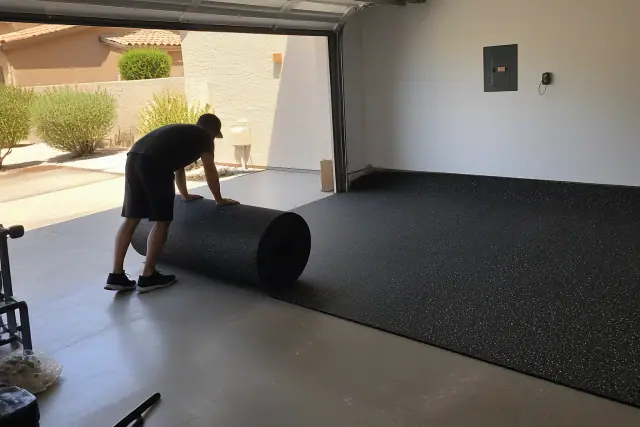
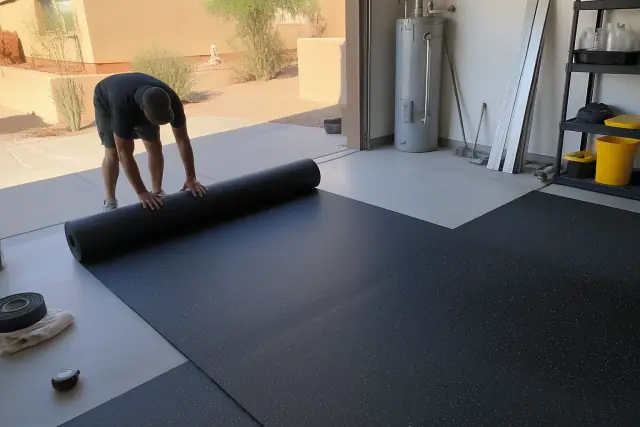
A worker installing rolled rubber flooring in a sunny Phoenix, AZ garage.

We install rolled goods with full-spread adhesive for most commercial floors and loose-lay methods for qualifying smaller rooms. Seam layout, slab moisture, traffic, and equipment load determine the final application plan.

Request Estimate

Home Gym Flooring Installation

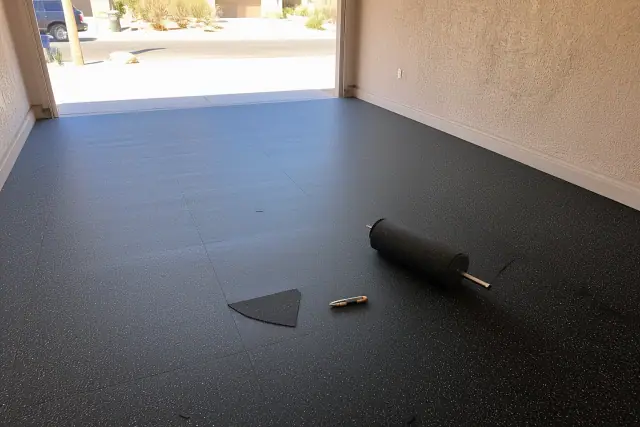
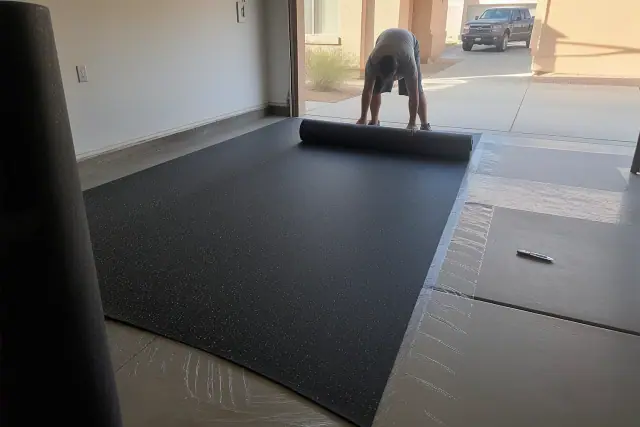
Rolled rubber flooring installation on a concrete garage floor in Phoenix, AZ.

Home gym plans account for dumbbells, cardio equipment, squat racks, lifting platforms, doorway height, and seams outside primary movement zones. Gilbert garage conversions and bonus rooms commonly span 200 to 400 square feet, so careful layout can limit waste and awkward transitions.

Request Estimate

Commercial Gym Flooring Installation

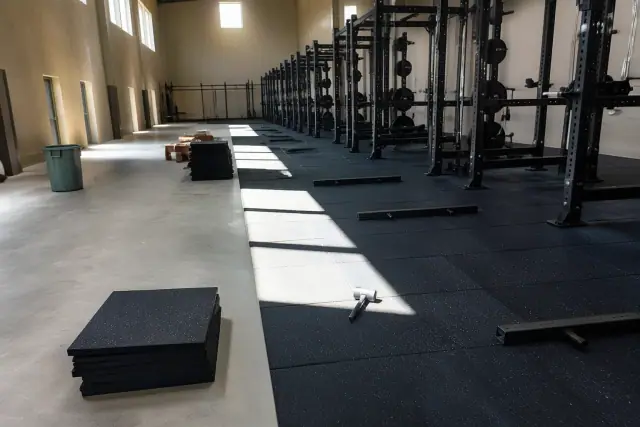
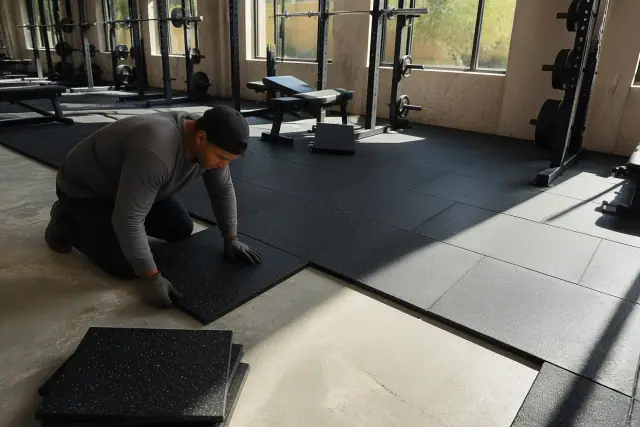
Technician installing heavy-duty rubber gym flooring onto a concrete slab in a Phoenix, AZ gym.

Commercial installations are planned for constant equipment movement, heavy free-weight impact, cardio lanes, and turf transitions. From boutique studios in Old Town Scottsdale to large gyms off the 101, 8mm and 9mm rolled rubber provide durable, uniform coverage.

Request Estimate

Poured-in-Place Rubber Flooring

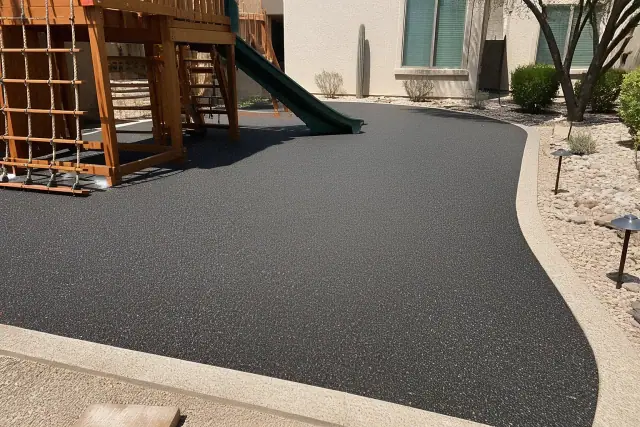
Technician troweling rubber flooring around play equipment in a Phoenix, AZ residential yard.

Poured systems create a seamless surface at a custom thickness through a labor-intensive troweling and curing process. They suit spaces that prioritize continuous coverage and can accommodate a higher installed cost than rolled material.

Request Estimate

Interlocking Rubber Tile Installation

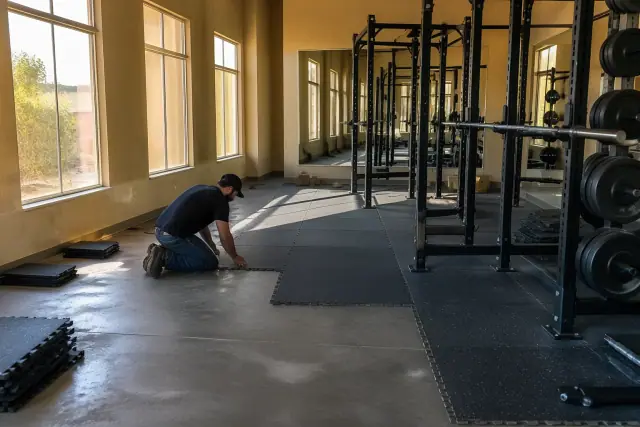
Technician installing rubber floor tiles in a Phoenix, AZ fitness center free weight zone.

Interlocking tiles install faster than fully adhered rolls and allow individual sections to be replaced more easily. They are a practical alternative for smaller gyms and rooms where future reconfiguration matters more than a nearly seamless appearance.

Request Estimate

Rubber Flooring Repair and Replacement

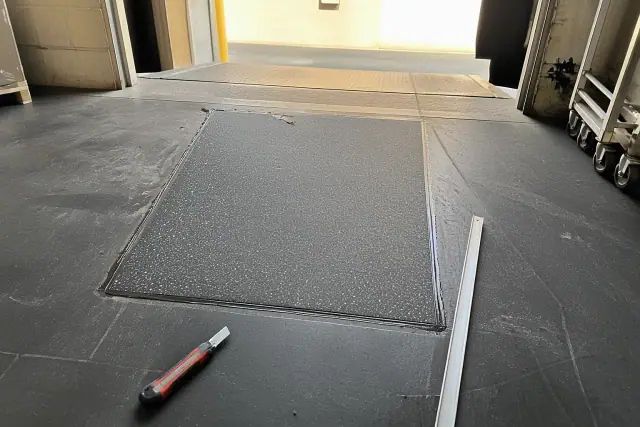
A rubber flooring patch repair near a warehouse loading dock in Phoenix, AZ.

We assess lifted seams, adhesive failures, and UV-damaged edges near sun-exposed garage doors. When the subfloor and surrounding material allow, targeted repair can address the failed area without replacing the entire floor.

Request Estimate
Material Options

Types of Rubber Flooring Options

The right format depends on equipment weight, traffic, room size, odor and color preferences, moisture conditions, and budget. These material categories cover the most common residential and commercial choices in the Phoenix market.

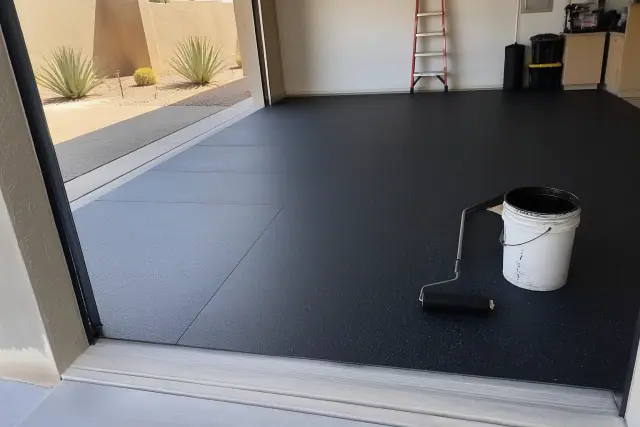
8mm rolled rubber flooring installed in a residential garage workshop in Phoenix, AZ.

8mm Rolled Rubber

8mm rolled rubber suits general fitness use, cardio zones, and home gyms with moderate dumbbell loads. It provides useful impact absorption without creating excessive height at doorway transitions.

  • General home gym and light commercial use
  • Cardio equipment and moderate dumbbell zones
  • Lower profile at doorways and transitions
  • Available in standard 4-foot-wide rolled goods
  • Compatible with adhered or qualifying loose-lay plans
Request Estimate
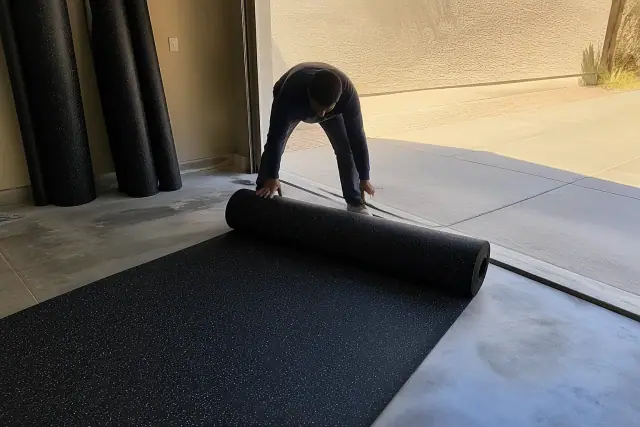
A worker unrolling heavy-duty recycled rubber flooring on a concrete garage floor in Phoenix, AZ.

9mm and Heavy-Duty Rubber

9mm and thicker rubber is better suited to Olympic lifting platforms, CrossFit-style boxes, and commercial free-weight areas. We match thickness to the equipment and expected drops instead of defaulting to the lowest-cost gauge.

  • 9mm coverage for dedicated lifting and heavy commercial use
  • 3/8-inch to 1/2-inch rubber for typical home lifting rooms
  • 3/4-inch or double-layered 8mm and 9mm systems for Olympic lifting platforms
  • Greater protection from daily plate drops and repeated impact
  • Equipment-based selection to reduce premature compression
Request Estimate
Worker installing recycled SBR rubber flooring in a garage workshop in Phoenix, AZ.

Recycled SBR Rubber

Recycled SBR flooring uses reclaimed tire rubber to deliver durable coverage at a lower material cost. It is well suited to performance-focused rooms where uniform color and initial odor are secondary concerns.

  • Made from reclaimed tire rubber
  • Affordable option for garages, home gyms, and utility rooms
  • Basic black surfaces prioritize performance over color consistency
  • Initial rubber odor generally fades within days to a few weeks with ventilation
  • Standard 1/8-inch material typically costs $2 to $3 per square foot before installation
Request Estimate
Worker installing sheets of recycled rubber flooring in a garage in Phoenix, AZ.

Virgin EPDM Rubber

Virgin EPDM rubber supports color-fast, lower-odor installations where appearance and indoor use guide the specification. Premium formulations and color flecking cost more than basic black recycled rubber.

  • Color-fast material for design-sensitive rooms
  • Lower-odor option for occupied indoor spaces
  • Color flecking and broader finish choices
  • Low-VOC-certified products available when a facility specification requires them
  • Suitable for sealed sheet-goods plans in therapy rooms and rehab gyms
Request Estimate
Technician installing rubber floor tiles in a fitness center free weight zone in Phoenix, AZ.

Interlocking Tiles and Poured Systems

Interlocking tile and poured-in-place rubber provide alternatives when standard rolls do not fit the room's priorities. One favors speed and replaceability; the other favors a seamless, custom-thickness finish.

  • Interlocking tiles install faster than fully adhered rolls
  • Damaged tile sections can be replaced individually
  • Poured rubber creates continuous coverage at a custom thickness
  • Poured-in-place installation runs closer to $16 per square foot because of troweling and curing labor
  • Rolled rubber remains the choice for fewer seams across large open floors
Request Estimate
Finding Your Right Fit

Choosing the Right Rolled Rubber Approach

A useful recommendation starts with the concrete, the equipment plan, and the room's daily use. We combine slab testing, measured material planning, and knowledge of Phoenix construction conditions before selecting thickness, adhesive, and seam treatment.

Concrete Moisture Testing

Every project begins with concrete moisture evaluation, including ASTM F2170 in-situ relative humidity probes. If testing shows elevated vapor conditions, we address moisture mitigation before adhesive is applied.

Equipment-Based Material Planning

We measure equipment footprints, columns, doorways, floor drains, and anchors before laying out the rolls. Material calculations typically include 5 to 10 percent extra for cuts, while the seam plan keeps joins out of primary lifting and traffic lanes.

Phoenix Slab Experience

Older downtown Phoenix buildings may need moisture mitigation, while newer developments may already have foundation vapor barriers. Familiarity with caliche soil, seasonal groundwater shifts, and local slab construction helps the assessment focus on the conditions that affect adhesion.

What Sets Us Apart

Why Choose Us for Rolled Rubber Flooring Installation?

Before quoting, we measure the room, photograph slab conditions, and identify cracks, joints, HVAC vents, floor drains, and flooring that needs removal. Installation then follows the selected manufacturer's guidelines and RFCI-recommended practices for adhesive, acclimation, and seam treatment, with equipment protected or moved in phases when an active gym cannot fully close.

Request Installation Estimate

Extreme Heat and UV Exposure

Materials not built for the Sonoran Desert can curl or break down within a single monsoon season. Direct sunlight through uncoated windows and at garage doors can also fade rubber or damage exposed edges, so product choice and edge detailing matter.

Slab Moisture and Adhesive Failure

Elevated moisture is more common in older slabs and buildings near the Salt River Valley floodplain. Installing over an unmitigated high-moisture slab can lead to bubbling, adhesive failure, or mold beneath the flooring.

Lifted or Separating Seams

Incorrect adhesive, inadequate roller pressure, or poorly planned loose-lay seams can let edges lift or separate. In some DIY installations, those failures appear within the first year and require rebonding or targeted replacement.

Impact Noise and Vibration

Upstairs gyms can transmit dropped-weight vibration through floor joists into living areas below. Thicker rubber and interlocking underlayment can reduce that transfer in two-story production homes such as those in Verrado and Estrella.

Undersized Flooring for Heavy Loads

A thin surface under Olympic bars or daily plate drops can transmit excess shock and compress prematurely within a couple of years. Choosing between 8mm, 9mm, and thicker assemblies should follow the equipment plan rather than price alone.

Uneven Slabs and Difficult Transitions

Cracks, control joints, expansion joints, drains, and doorway transitions can telegraph through a finished floor or interrupt a seam plan. We check flatness with a 10-foot straightedge and identify these conditions before the material is ordered.

How it works

Our Rolled Rubber Flooring Process

The installation sequence moves from room and slab assessment through material layout, bonding, seam finishing, and final inspection. Each step is adjusted to the product, moisture results, room size, and operating needs of the property.

01.

Walkthrough and Measurements

We measure the room, photograph the slab, and document existing flooring, HVAC vents, drains, columns, doorways, and equipment anchors. The walkthrough defines demolition, access, phasing, and transition needs before the quote is finalized.

02.

Slab Testing and Subfloor Prep

We check flatness, repair relevant cracks, and test concrete moisture. Calcium chloride results under 3 lbs per 1,000 square feet per 24 hours generally do not call for a separate vapor barrier, while higher readings prompt a moisture-mitigation coating before installation.

03.

Acclimation and Seam Layout

The rolls acclimate at room temperature for 24 to 48 hours before cutting. We plan around standard 4-foot widths, include the expected 5 to 10 percent cutting waste, and keep cross-seams away from high-traffic lanes.

04.

Adhesive or Loose-Lay Installation

Most commercial floors receive full-spread adhesive applied with a 1/4-inch square-notch trowel, followed by a 100-pound roller to remove air and create full contact. Qualifying home gyms under 500 square feet may use perimeter weight or double-sided seam tape in a loose-lay plan.

05.

Seam Finishing and Sealing

Depending on the product, seams are heat-welded or chemically welded and the finished floor is sealed. Limiting moisture and bacteria intrusion at seam lines is especially important for healthcare, school, therapy, and rehab spaces.

06.

Cure Time and Final Walkthrough

The installed floor typically cures for 24 to 48 hours before full foot traffic. We then inspect seams, edges, doorway transitions, and protected equipment with the customer and handle needed adjustments before closing the job.

Plan Your Flooring

Schedule a Rolled Rubber Flooring
Consultation

Tell us about the room, slab, equipment, and preferred rubber format. After assessing the space, we provide a written quote so material, labor, preparation, and seam-finishing costs are clear before work begins.

Installation Help

Rolled Rubber Flooring FAQs

Use these answers to compare costs, materials, thicknesses, slab requirements, and installation methods for a Phoenix rubber flooring project.

Call About Installation

Rolled rubber typically runs $3 to $15 per square foot for material and labor, while rubber tile averages around $10 per square foot installed and labor alone is about $2 per square foot. A straightforward 144-square-foot home gym often falls between $800 and $1,500 installed. Poured-in-place rubber runs closer to $16 per square foot, or roughly $2,300 for a standard-size room, because it requires more troweling and curing labor.

Recycled rubber can have a noticeable initial odor, darker colors can show dust, and the material offers fewer design choices than some alternatives. Oils, harsh solvents, citrus-based cleaners, and prolonged direct sun can damage or fade the surface. Its upfront cost can also exceed basic carpet or vinyl, although it is designed for more demanding gym use.

Installation begins with cleaning, crack treatment, flatness checks, and concrete moisture testing. After the rolls acclimate, they are cut to the seam plan and either bonded with notched-trowel adhesive and a heavy roller or loose-laid with perimeter weight and seam tape in a qualifying small room. Seams are butted, heat-welded, or chemically welded as the product requires.

Usually not when the slab is properly cured and calcium chloride results remain under 3 lbs per 1,000 square feet per 24 hours. Elevated readings call for a moisture-mitigation coating rather than automatically adding a traditional vapor barrier. Testing is essential because skipping mitigation can lead to adhesive failure or mold beneath the floor.

At the typical $3 to $15 per-square-foot range, a 2,000-square-foot commercial floor can run from $6,000 to $30,000. Standard 8mm rolled rubber with full-spread adhesive often lands near the middle once labor, adhesive, and seam finishing are included. Subfloor mitigation, material thickness, and a poured-in-place specification can move the price higher.

DIY can work for a small, low-traffic home gym using loose-lay rolls or interlocking tiles. Larger rooms, full-spread adhesive, and slabs with moisture concerns benefit from professional testing and installation. The wrong adhesive or too little roller pressure can cause bubbling or seam separation.

8mm works for general fitness, cardio, home gyms, and moderate dumbbell use, while 9mm better suits Olympic lifting, CrossFit-style boxes, and heavy commercial free-weight areas. Typical home gym coverage ranges from 3/8 inch to 1/2 inch. Dedicated platforms may call for 3/4-inch material or double-layered 8mm and 9mm systems.

A properly installed rubber floor can last 10 to 20 years with basic maintenance. Service life depends on thickness, equipment impact, traffic, sunlight, chemical exposure, and the quality of the slab preparation and adhesive bond.

The material should acclimate at room temperature for 24 to 48 hours before cutting and bonding. After installation, the floor typically needs another 24 to 48 hours before full foot traffic. Product, adhesive, room conditions, and seam treatment determine the exact schedule.

Yes, when the specified product and installation details meet the facility's requirements. Healthcare and school projects may call for sealed sheet goods, welded seams, ADA slip resistance, and product documentation for ASTM E648 critical radiant flux. Facility managers should review product data sheets before material is ordered.

Sweep regularly and damp mop occasionally with a pH-neutral cleaner. Avoid harsh solvents, citrus-based products, and prolonged oil exposure because they can break down the rubber surface over time. Follow the flooring manufacturer's maintenance instructions for the installed product.

Rolled rubber creates fewer seams and a more uniform surface across large cardio and training floors. Interlocking tiles install faster and make individual section replacement easier. The better choice depends on room size, traffic, equipment, appearance, and whether the floor may need to be reconfigured.

Material plans typically include 5 to 10 percent extra for cuts around columns, doorways, drains, and equipment anchors. Because rolled goods commonly come in 4-foot widths, seam layout also affects waste. Accurate field measurements are more reliable than ordering from room dimensions alone.