Can You Prove Your Credentials?
Request the contractor's Arizona ROC license number plus current bonding and liability insurance documents. The license status can be checked through the Arizona Registrar of Contractors in under a minute.
Phoenix Rubber Flooring recommends asking for proof of licensing, bonding, and liability insurance; material-specific experience; a written, itemized scope; subfloor preparation details; a realistic schedule; and separate labor and product warranty terms before you sign. Clear answers protect your budget and make it easier to compare contractors on the same work.
Request the contractor's Arizona ROC license number plus current bonding and liability insurance documents. The license status can be checked through the Arizona Registrar of Contractors in under a minute.
Ask about experience with your specific flooring, not flooring in general. Confirm whether employees or subcontractors will install it, and request examples from comparable local projects.
Have the contractor list inclusions and exclusions in writing, including preparation, furniture moving, removal, haul-away, trim, and transitions. Tie deposits and later payments to material ordering or clear project milestones.
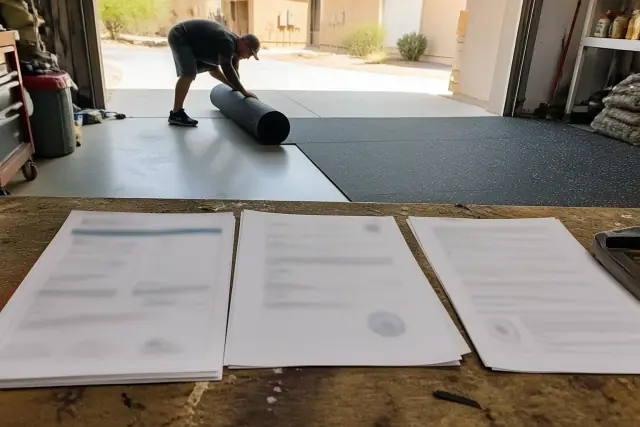
These documents let you verify who will be responsible for the work before signing. Names and license details should match the written contract.
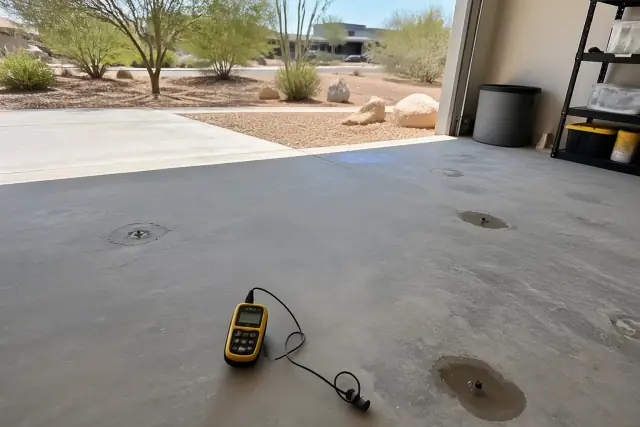
A moisture reading and flatness check show whether a slab is ready or needs preparation. This is especially important for resilient and wood flooring, where skipped testing can contribute to adhesive failure or cupping.
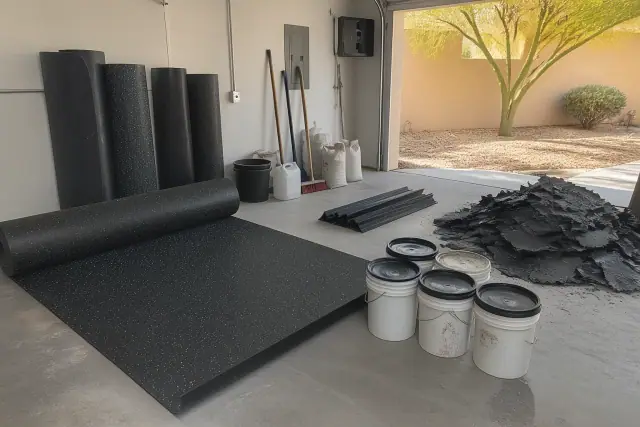
A useful quote separates material, labor, removal, subfloor repairs, trim, and transitions. Separate lines make it easier to compare bids without overlooking excluded work.
Ask for verifiable licensing, bonding, insurance, material-specific experience, crew details, and comparable local work.
Confirm moisture testing, floor leveling, acclimation, expansion gaps, substrate requirements, and the repair approval process.
One Phoenix quote example separated installation at $4.00 per square foot from roughly 225 linear feet of shoe mould. Ask for the same line-item clarity and milestone-based payments.
Get start and completion estimates, cleanup responsibility, a point of contact, written labor coverage, separate product coverage, transfer terms, and a claim process.
| Question Area | A Complete Answer Covers | Warning Sign |
|---|---|---|
| Credentials | Arizona ROC license number, bonding, and liability insurance | Documents or license details are withheld |
| Subfloor | Moisture testing, flatness, repairs, and material-specific preparation | The existing surface will be covered without testing |
| Price | Material, labor, removal, subfloor work, trim, and payment milestones | One lump sum or full payment before work starts |
| Schedule | Start date, expected completion, crew responsibility, cleanup, and disposal | Vague dates and no named point of contact |
| Warranty | Written labor term, separate product coverage, transferability, and claim contact | Only a verbal promise is offered |
The best questions require proof, scope, and responsibility instead of simple yes-or-no answers. Use the rule of 3: compare at least three written contractor quotes and at least three flooring samples in the room's actual lighting. Then check that each bid covers the same preparation, materials, labor, disposal, schedule, and warranty terms.
Material, property type, and site conditions change which answers matter most. Across Phoenix's 517.9 square miles and more than 1.6 million residents, projects range from historic bungalows near Encanto Park and older homes in Willo or Coronado to new builds in Desert Ridge; subfloor conditions can differ accordingly. Hardwood may need 48 to 72 hours of acclimation in the home's climate-controlled air, while vinyl plank calls for flatness and expansion-gap questions, tile calls for substrate deflection and thin-set coverage questions, and carpet calls for padding density and installation-method questions. Ask whether applicable work follows guidance from the National Wood Flooring Association, Resilient Floor Covering Institute, Tile Council of North America, or Carpet and Rug Institute, and discuss intense sun exposure, hard water, and dust when they affect finish selection or care.
How much might flooring cost? National installation costs in the source range from $3 to $15 per square foot depending on material and labor; vinyl tile installation is commonly around $1.75 to $2.00 per square foot, while ceramic tile removal averages about $1.25 per square foot as a separate charge. What are major red flags? Be cautious about full payment upfront, same-day signature pressure, a verbal quote, missing material specifications, or an installer who cannot explain subfloor moisture testing. How should warranty questions be framed? Ask how a defect discovered six months later would be handled, who receives the claim, how long the written labor coverage lasts, how it differs from product coverage, and whether either warranty transfers when the home is sold.
Share the flooring material, room conditions, and written scope you are considering. A local flooring team can help clarify preparation, installation, scheduling, and warranty questions before you approve the project.